The Graphic Score Exchange has been set up to promote alternative forms of musical notation.
Musicians of all ages and musical backgrounds are invited to participate in this exciting collaborative project, from professional composers to amateurs. Whatever your skill level, you are welcome to take part as a composer or/and a performer. Composers are to upload graphic scores to the score gallery, and musicians will be invited to respond with a recording of their interpretation of the score.
A driving motivation behind the Graphic Score Exchange is to bring people together in a time of social isolation. During the pandemic, restrictions on social gatherings have led to a significant reduction in opportunities for musicians. Unable to collaborate in-person, this online space provides the opportunity for composers and performers to connect with each other virtually.
Participating composers will be able to hear their score performed by other musicians in a supportive and stimulating environment – offering an intimate connection between strangers during a period of isolation. The Graphic Score Exchange is committed to community building, encouraging collaboration between professional and amateur composers and musicians. Graphic notation can open up new possibilities for many, giving a voice to those who find traditional notation limiting yet have the desire to express themselves through composition
How to take part
Compose a graphic score
Scores should be written for open instrumentation only rather than specific instruments. Think about how you would like the musicians to respond to visual elements, considering shape, colour, size and placement. The score can be abstract or instructional.
You may use symbols, shapes, words and colours to represent the sounds on the page. Responses may be wide ranging – from digital art, to abstract painting or sketches, to video score/animation – wherever your imagination takes you, be as creative as you wish!
Click here to submit a sore
Perform a score
All instruments and skill levels are welcome!
Browse the score gallery and select the graphic score you wish to perform.
Click here to send in your interpretation
What is graphic notation?
In the mid 20th Century, experimental composers such as John Cage and Cornelius Cardew began using graphic scores as an alternative method of writing down music. The traditional staff was substituted for symbols, shapes and lines. In an effort to blur the lines between composer and performer, these scores were often indeterminate in nature, leaving interpretation open to the players. This new way of writing down sound made musical scores more accessible, as the ability to read music was not an essential requirement.
Graphic scores serve as an invitation rather than a strict set of rules to be followed. Approaching composition from a non-hierarchical perspective, boundaries between composer and performer are effectively erased. The incorporation of chance processes (Cage’s use of I Ching for instance) to determine musical outcomes demonstrates a removal of the composer’s ego. This is paralleled in the way many graphic scores allow greater input from the performers. In return, this results in unpredictable musical outcomes; a single score can result in a completely unique performance each time it is played.
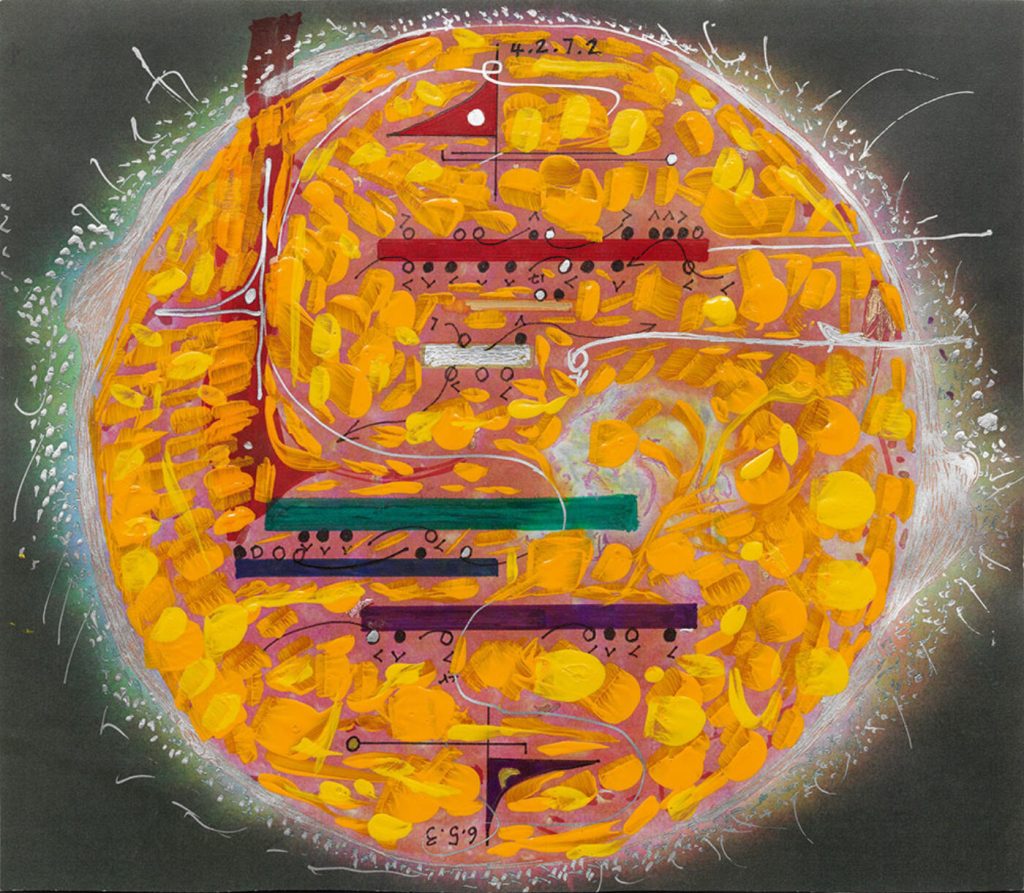
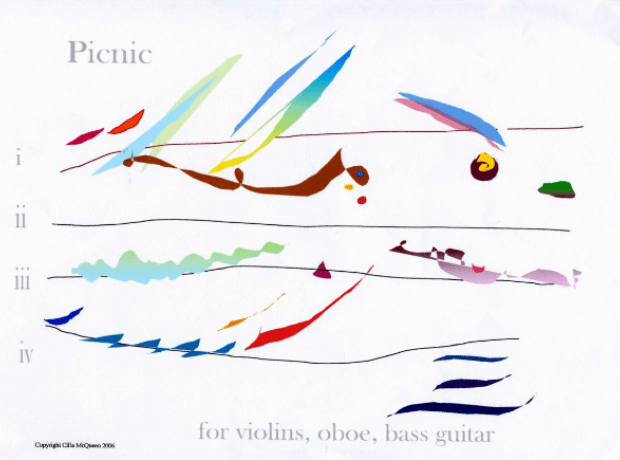
A graphic score can take on several different formats. Some scores are abstract, providing a framework for improvisation, whilst others are more instructional. Rather than using conventional staff notation, sonic elements are represented visually using geometric forms and various other graphical elements. It is up to the performer to decide how they portray the visuals through music, taking into account pitch, dynamics, rhythm and timbre. When interpreting graphic scores, performers must not only consider shapes, but also absence and space. In an interdisciplinary act of combining art and music, graphic notation encourages collaboration between artists from all creative fields.
Here are some examples of graphic scores
Text scores
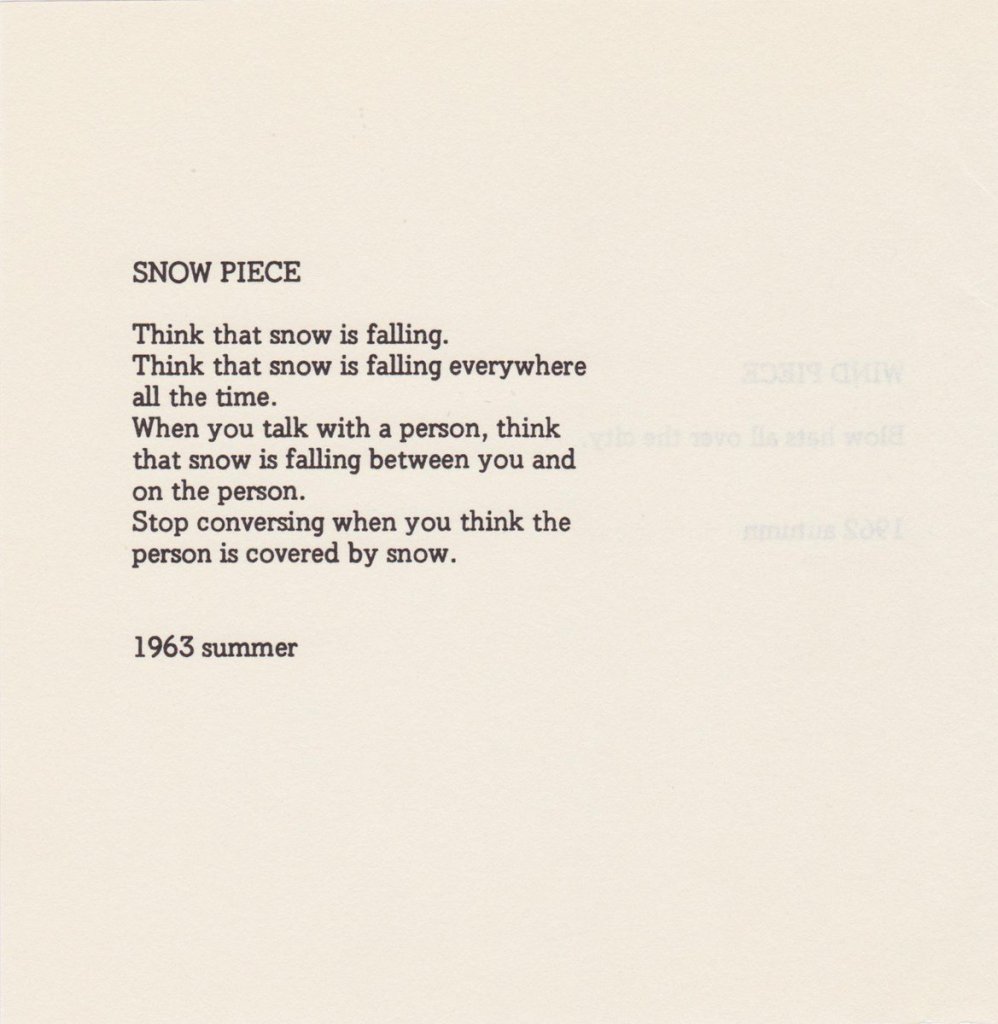
Similarly, text scores use language as a prompt for action, in the form of poetry, prose or instructions. Text scores can be conceptual – take Yoko Ono’s ‘Snow Piece’ (1963) for example, which involves imaginary actions.
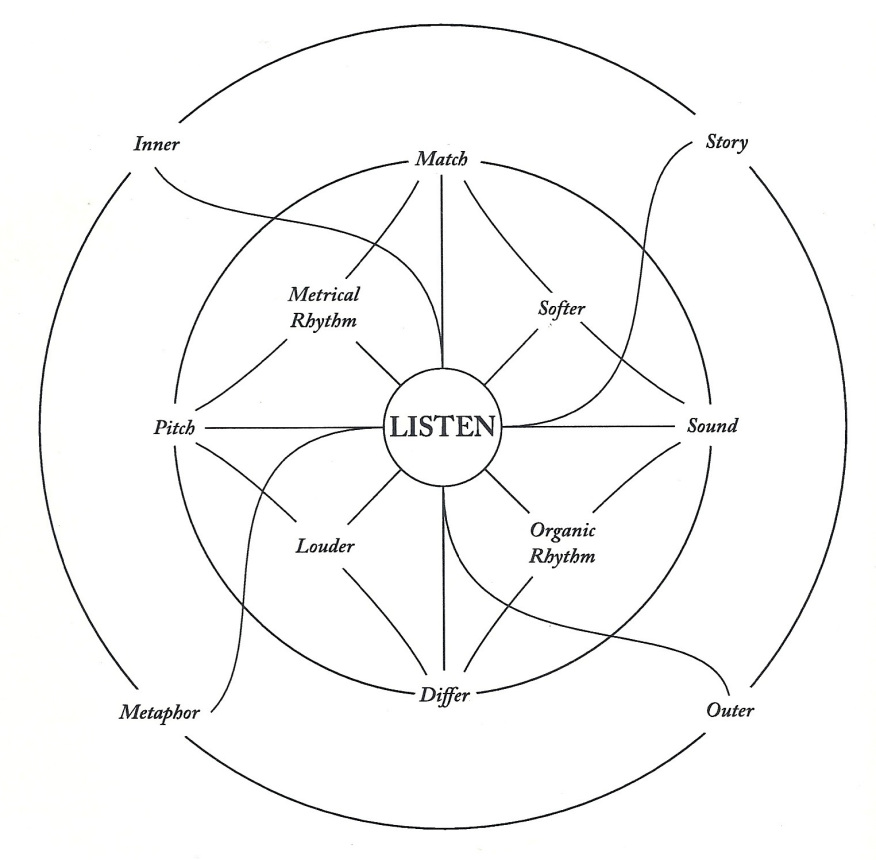
Other text scores focus on the act of listening as opposed to producing sound; this is seen in Pauline Oliveros’ Sonic Meditations (1971), which encourage unique approaches to listening with the aim of developing the performer/listener’s sonic awareness. ‘Wind Horse Mandala’ (1990) in particular demonstrates a combination of graphics and language as a form of notation.
Here is an instructional piece by Christian Wolff titled ‘Stones’.

Further Resources
Playing pictures: the wonder of graphic scores
https://www.theguardian.com/music/2013/oct/07/graphic-music-scores-playing-pictures-tom-phillips
The art of visualising music: a brief history of graphic notation
 GRAPHIC SCORE EXCHANGE